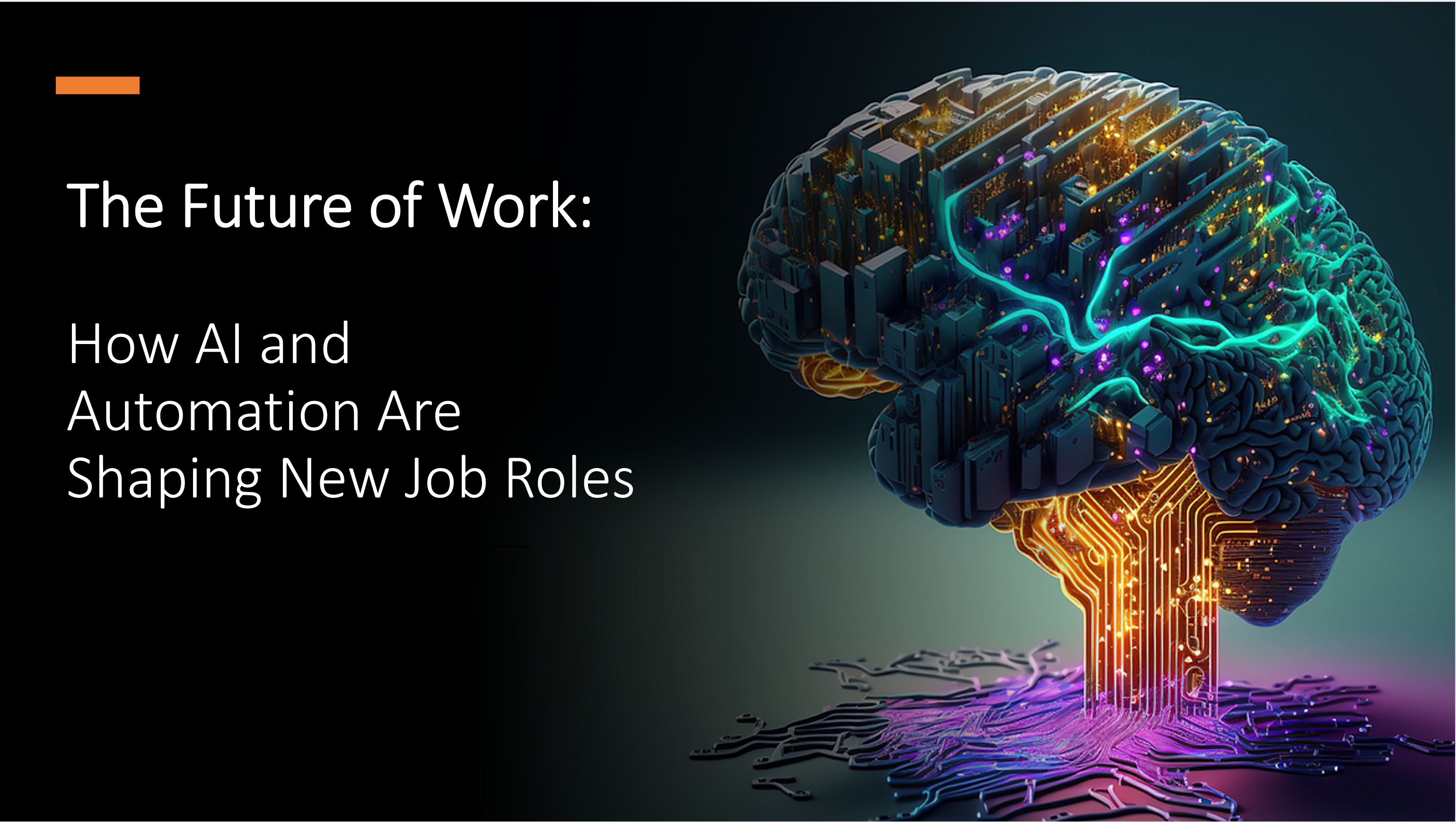

After two decades of architecting enterprise systems and leading digital transformation initiatives across financial services, healthcare, and technology sectors, I’ve witnessed firsthand how AI and automation are fundamentally reshaping the nature of work. This isn’t merely about replacing tasks—it’s about reimagining entire value chains, creating new categories of roles, and demanding a fundamental shift in how we think about human-machine collaboration.
The Automation Imperative: Beyond the Hype
The conversation around AI and automation often oscillates between utopian promises and dystopian fears. Having implemented automation solutions across dozens of enterprises, I can tell you the reality is far more nuanced. The organizations that thrive are those that approach automation strategically—understanding not just what can be automated, but what should be automated, and more importantly, how to augment human capabilities rather than simply replace them.
The key insight from my experience: automation ROI isn’t just about cost reduction. The most successful implementations I’ve led focused on freeing human talent for higher-value work, improving accuracy in critical processes, and enabling scale that would be impossible with manual approaches alone.
The Automation Spectrum: From RPA to Intelligent Automation
Understanding the automation landscape requires recognizing that it exists on a spectrum. At one end, you have basic Robotic Process Automation (RPA)—rule-based bots that handle repetitive, structured tasks. At the other end, you have fully autonomous AI systems capable of complex decision-making. Most enterprise implementations fall somewhere in between, combining multiple technologies in what we call “Intelligent Automation” or “Hyperautomation.”
When to Use What: RPA Platforms
UiPath has emerged as the market leader for enterprise RPA, and for good reason. Its visual workflow designer makes it accessible to citizen developers while offering the depth that professional developers need. I recommend UiPath when you need extensive integration capabilities, have a large-scale deployment planned, or require robust governance and security features. The platform excels in regulated industries like financial services and healthcare. Cost-wise, it’s premium-priced but delivers strong ROI for complex, high-volume scenarios.
Automation Anywhere offers a compelling cloud-native architecture that’s particularly attractive for organizations committed to SaaS-first strategies. Its IQ Bot capabilities for document processing are industry-leading. Choose Automation Anywhere when cloud deployment is a priority, you need strong document processing capabilities, or you’re looking for a more consumption-based pricing model. It’s particularly cost-effective for mid-sized deployments.
Blue Prism pioneered the enterprise RPA space and remains strong in highly regulated environments. Its architecture emphasizes security and auditability, making it the go-to choice for banks, insurance companies, and government agencies with stringent compliance requirements. However, it has a steeper learning curve and typically requires more technical expertise to implement effectively.
When to Use What: AI/ML Platforms
AWS SageMaker is my default recommendation for organizations already invested in the AWS ecosystem. Its end-to-end ML capabilities—from data labeling through deployment and monitoring—are unmatched. SageMaker excels when you need to train custom models at scale, require tight integration with other AWS services, or have teams comfortable with the AWS paradigm. The pay-as-you-go pricing can be cost-effective for variable workloads but requires careful management to avoid runaway costs.
Azure Machine Learning offers the best integration with Microsoft’s enterprise ecosystem. If your organization runs on Microsoft 365, Dynamics, or has significant .NET investments, Azure ML provides seamless integration that accelerates time-to-value. Its AutoML capabilities are particularly strong for organizations without deep ML expertise. Azure ML also offers compelling hybrid deployment options for organizations with on-premises requirements.
Google Vertex AI leads in cutting-edge ML capabilities, particularly for organizations working with unstructured data, computer vision, or natural language processing. Google’s pre-trained models and transfer learning capabilities can dramatically reduce development time. Choose Vertex AI when you need state-of-the-art model performance, are working on innovative AI applications, or have teams with strong Python/TensorFlow expertise.
When to Use What: Generative AI Platforms
OpenAI (GPT-4, GPT-4 Turbo) remains the benchmark for general-purpose generative AI. Its API is well-documented, the model capabilities are consistently strong across diverse tasks, and the ecosystem of tools and integrations is the most mature. I recommend OpenAI for customer-facing applications where response quality is paramount, content generation at scale, and rapid prototyping. Be mindful of data privacy implications—OpenAI’s data handling policies may not suit all enterprise requirements.
Anthropic (Claude) has emerged as the enterprise-friendly alternative, with strong emphasis on safety, longer context windows, and more nuanced handling of complex instructions. Claude excels in document analysis, technical writing, and scenarios requiring careful reasoning. I increasingly recommend Claude for internal enterprise applications, particularly in regulated industries where Anthropic’s constitutional AI approach provides additional comfort around safety and reliability.
Open Source Models (Llama, Mistral, etc.) offer compelling alternatives when data sovereignty, customization, or cost optimization are priorities. Running models on your own infrastructure eliminates per-token costs and keeps sensitive data in-house. However, this approach requires significant ML engineering expertise and infrastructure investment. I recommend open source for organizations with strong technical teams, specific customization requirements, or strict data residency requirements.
Decision Matrix: Choosing Your Automation Stack
| Scenario | Recommended Stack | Key Considerations |
|---|---|---|
| High-volume document processing in regulated industry | UiPath + Azure ML + Claude | Compliance, auditability, accuracy |
| Customer service automation for e-commerce | Automation Anywhere + OpenAI GPT-4 | Response quality, scalability, cost per interaction |
| Predictive maintenance in manufacturing | AWS SageMaker + custom models | Real-time inference, IoT integration, edge deployment |
| Internal knowledge management | Open source LLM + RAG architecture | Data privacy, customization, total cost of ownership |
| Healthcare clinical decision support | Azure ML + Blue Prism + Claude | HIPAA compliance, explainability, integration with EHR |
| Financial fraud detection | AWS SageMaker + UiPath | Real-time processing, model monitoring, regulatory reporting |
Emerging Roles in the AI-Augmented Workplace
The transformation isn’t just about technology—it’s creating entirely new career paths. Based on hiring patterns I’ve observed across my client base, these roles are seeing explosive demand:
AI/ML Engineers who can bridge the gap between data science experimentation and production deployment. The ability to operationalize models—handling versioning, monitoring, and scaling—is now as valuable as building them.
Prompt Engineers have emerged as a distinct specialty, optimizing how humans interact with large language models. This role requires a unique blend of linguistic skill, domain expertise, and systematic experimentation.
AI Ethics Officers are becoming essential as organizations grapple with bias, fairness, and accountability in automated decision-making. This role requires both technical understanding and strong grounding in ethics and governance.
Automation Architects design end-to-end automation strategies, selecting appropriate technologies and ensuring they work together coherently. This is the role I most frequently help organizations define and fill.
Skills for the AI Era: A Practical Framework
For professionals navigating this transition, I recommend focusing on three skill categories:
Technical Fluency: You don’t need to become a data scientist, but understanding how AI systems work, their capabilities and limitations, and how to evaluate their outputs is essential. Learn to read model documentation, understand basic ML concepts, and critically evaluate AI-generated content.
Human-AI Collaboration: The most valuable professionals will be those who can effectively partner with AI systems—knowing when to trust AI outputs, when to override them, and how to provide feedback that improves system performance over time.
Domain Expertise: As AI handles more routine cognitive tasks, deep domain expertise becomes more valuable, not less. The ability to apply judgment, understand context, and make decisions that AI systems cannot is increasingly premium.
Implementation Best Practices
From hundreds of automation implementations, here are the patterns that consistently drive success:
Start with process excellence: Automating a broken process just creates faster failures. Before any automation initiative, map and optimize the underlying process.
Build for observability: Automated systems need robust monitoring, logging, and alerting. You should know when something goes wrong before your customers do.
Plan for the human handoff: Every automation should have clear escalation paths for edge cases. The goal is augmentation, not complete replacement.
Invest in change management: Technical implementation is often the easy part. Helping people adapt to new ways of working requires sustained attention and resources.
Looking Ahead: The Next Five Years
Based on current trajectories and my conversations with technology leaders across industries, I expect several developments to reshape the landscape:
Multimodal AI will become standard, with systems that seamlessly process text, images, audio, and video together. This will unlock automation possibilities in areas currently requiring human perception.
AI agents—systems that can plan, execute multi-step tasks, and learn from outcomes—will move from research to production. This represents a fundamental shift from AI as a tool to AI as a collaborator.
The regulatory landscape will mature, with clearer frameworks for AI governance, liability, and accountability. Organizations that build compliance into their AI strategies now will have significant advantages.
Conclusion
The future of work isn’t about humans versus machines—it’s about humans with machines. The professionals and organizations that thrive will be those that thoughtfully integrate AI and automation capabilities while preserving and enhancing uniquely human contributions. The technology is evolving rapidly, but the fundamental challenge remains constant: how do we use these powerful tools to create more value, more opportunity, and more meaningful work?
As someone who has spent two decades at the intersection of technology and business transformation, I remain optimistic. The opportunities for those willing to adapt, learn, and lead are unprecedented. The question isn’t whether AI will transform your industry—it’s whether you’ll be among those shaping that transformation or responding to it.
Discover more from C4: Container, Code, Cloud & Context
Subscribe to get the latest posts sent to your email.