Introduction: LLM API costs can spiral quickly—a chatbot handling 10,000 daily users at $0.01 per conversation costs $3,000 monthly. Production systems need cost optimization without sacrificing quality. This guide covers practical strategies: semantic caching to avoid redundant calls, model routing to use cheaper models when possible, prompt compression to reduce token counts, and monitoring to catch cost anomalies early. These techniques can reduce costs by 50-80% while maintaining user experience.
- Part 1 (this article): Reducing API spend without sacrificing quality
- Part 2: Model routing, token reduction, and budget management
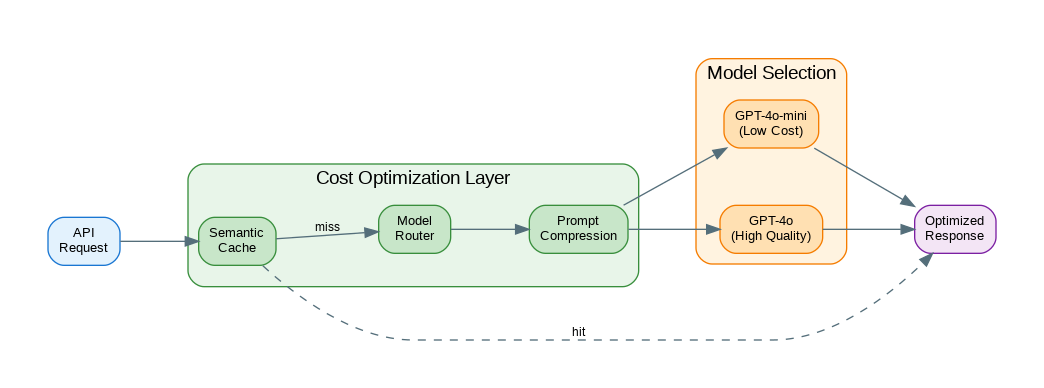
Cost Optimization Architecture
Effective cost management requires visibility, control, and optimization at every layer. This diagram shows the key components of a cost-optimized LLM system.
flowchart TB
    subgraph Input["Request Processing"]
        REQ[Request]
        PC[Prompt Compressor]
        TL[Token Limiter]
    end

    subgraph Cache["Caching Layer"]
        SC[Semantic Cache]
        VDB[(Vector DB)]
    end

    subgraph Routing["Smart Routing"]
        CL[Complexity Classifier]
        MR[Model Router]
    end

    subgraph Models["Model Tier"]
        T1[Tier 1: GPT-4o-mini
$0.15/1M]
        T2[Tier 2: GPT-4o
$5/1M]
        T3[Tier 3: o1
$15/1M]
    end

    subgraph Monitor["Cost Monitoring"]
        CT[Cost Tracker]
        BM[Budget Manager]
        AL[Alert System]
    end

    REQ --> PC
    PC --> TL
    TL --> SC
    SC -->|Hit| REQ
    SC -->|Miss| CL
    CL --> MR
    MR --> T1
    MR --> T2
    MR --> T3
    T1 --> CT
    T2 --> CT
    T3 --> CT
    CT --> BM
    BM --> AL

    style REQ fill:#E3F2FD,stroke:#90CAF9,stroke-width:2px,color:#1565C0
    style PC fill:#E8F5E9,stroke:#A5D6A7,stroke-width:2px,color:#2E7D32
    style TL fill:#E8F5E9,stroke:#A5D6A7,stroke-width:2px,color:#2E7D32
    style SC fill:#F3E5F5,stroke:#CE93D8,stroke-width:2px,color:#6A1B9A
    style VDB fill:#ECEFF1,stroke:#90A4AE,stroke-width:2px,color:#455A64
    style CL fill:#FFF3E0,stroke:#FFCC80,stroke-width:2px,color:#E65100
    style MR fill:#FFF3E0,stroke:#FFCC80,stroke-width:2px,color:#E65100
    style T1 fill:#E8F5E9,stroke:#A5D6A7,stroke-width:2px,color:#2E7D32
    style T2 fill:#FFF3E0,stroke:#FFCC80,stroke-width:2px,color:#E65100
    style T3 fill:#FCE4EC,stroke:#F48FB1,stroke-width:2px,color:#AD1457
    style CT fill:#E0F2F1,stroke:#80CBC4,stroke-width:2px,color:#00695C
    style BM fill:#E0F2F1,stroke:#80CBC4,stroke-width:2px,color:#00695C
    style AL fill:#E0F2F1,stroke:#80CBC4,stroke-width:2px,color:#00695C
Figure 1: C4 Container Diagram – Cost Optimization Architecture
Cost Tracking Foundation
The following code implements cost tracking foundation. Key aspects include proper error handling and clean separation of concerns.
from dataclasses import dataclass, field
from datetime import datetime, timedelta
from collections import defaultdict
import json

@dataclass
class ModelPricing:
    input_per_1k: float
    output_per_1k: float
    cached_input_per_1k: float = 0.0  # For providers with prompt caching

PRICING = {
    "gpt-4o": ModelPricing(0.0025, 0.01),
    "gpt-4o-mini": ModelPricing(0.00015, 0.0006),
    "gpt-4-turbo": ModelPricing(0.01, 0.03),
    "gpt-3.5-turbo": ModelPricing(0.0005, 0.0015),
    "claude-3-5-sonnet": ModelPricing(0.003, 0.015),
    "claude-3-haiku": ModelPricing(0.00025, 0.00125),
}

@dataclass
class UsageRecord:
    timestamp: datetime
    model: str
    input_tokens: int
    output_tokens: int
    cost: float
    endpoint: str = ""
    user_id: str = ""

class CostTracker:
    """Track and analyze LLM costs."""

    def __init__(self):
        self.records: list[UsageRecord] = []
        self.daily_budget: float = 100.0
        self.alert_threshold: float = 0.8

    def record(
        self,
        model: str,
        input_tokens: int,
        output_tokens: int,
        endpoint: str = "",
        user_id: str = ""
    ) -> float:
        """Record usage and return cost."""

        pricing = PRICING.get(model, ModelPricing(0.01, 0.03))

        cost = (
            (input_tokens / 1000) * pricing.input_per_1k +
            (output_tokens / 1000) * pricing.output_per_1k
        )

        record = UsageRecord(
            timestamp=datetime.now(),
            model=model,
            input_tokens=input_tokens,
            output_tokens=output_tokens,
            cost=cost,
            endpoint=endpoint,
            user_id=user_id
        )

        self.records.append(record)

        # Check budget
        daily_cost = self.get_daily_cost()
        if daily_cost > self.daily_budget * self.alert_threshold:
            print(f"WARNING: Daily cost ${daily_cost:.2f} approaching budget ${self.daily_budget:.2f}")

        return cost

    def get_daily_cost(self, date: datetime = None) -> float:
        """Get total cost for a day."""
        date = date or datetime.now()
        start = date.replace(hour=0, minute=0, second=0, microsecond=0)
        end = start + timedelta(days=1)

        return sum(
            r.cost for r in self.records
            if start <= r.timestamp < end
        )

    def get_cost_by_model(self, days: int = 7) -> dict[str, float]:
        """Get cost breakdown by model."""
        cutoff = datetime.now() - timedelta(days=days)

        costs = defaultdict(float)
        for r in self.records:
            if r.timestamp >= cutoff:
                costs[r.model] += r.cost

        return dict(costs)

    def get_cost_by_endpoint(self, days: int = 7) -> dict[str, float]:
        """Get cost breakdown by endpoint."""
        cutoff = datetime.now() - timedelta(days=days)

        costs = defaultdict(float)
        for r in self.records:
            if r.timestamp >= cutoff:
                costs[r.endpoint] += r.cost

        return dict(costs)

    def report(self) -> str:
        """Generate cost report."""

        today = self.get_daily_cost()
        by_model = self.get_cost_by_model(7)
        by_endpoint = self.get_cost_by_endpoint(7)

        return f"""
Cost Report
===========
Today: ${today:.4f}
Budget: ${self.daily_budget:.2f} ({today/self.daily_budget*100:.1f}% used)

Last 7 Days by Model:
{json.dumps(by_model, indent=2)}

Last 7 Days by Endpoint:
{json.dumps(by_endpoint, indent=2)}
"""

# Global tracker
tracker = CostTracker()
Semantic Caching
Caching dramatically reduces latency and costs by storing and reusing previous results. This implementation includes cache invalidation and TTL management.
import hashlib
import numpy as np
from openai import OpenAI
from typing import Optional

client = OpenAI()

class SemanticCache:
    """Cache responses for semantically similar queries."""

    def __init__(
        self,
        similarity_threshold: float = 0.95,
        max_entries: int = 10000,
        ttl_hours: int = 24
    ):
        self.threshold = similarity_threshold
        self.max_entries = max_entries
        self.ttl = timedelta(hours=ttl_hours)

        self.cache: dict[str, dict] = {}  # hash -> {embedding, response, timestamp}
        self.embeddings: list[tuple[str, list[float]]] = []  # (hash, embedding)

    def _get_embedding(self, text: str) -> list[float]:
        """Get embedding for cache lookup."""
        response = client.embeddings.create(
            model="text-embedding-3-small",
            input=text
        )
        return response.data[0].embedding

    def _cosine_similarity(self, a: list[float], b: list[float]) -> float:
        a, b = np.array(a), np.array(b)
        return np.dot(a, b) / (np.linalg.norm(a) * np.linalg.norm(b))

    def _find_similar(self, embedding: list[float]) -> Optional[str]:
        """Find similar cached query."""

        for cache_hash, cache_emb in self.embeddings:
            if cache_hash in self.cache:
                # Check TTL
                if datetime.now() - self.cache[cache_hash]["timestamp"] > self.ttl:
                    continue

                similarity = self._cosine_similarity(embedding, cache_emb)
                if similarity >= self.threshold:
                    return cache_hash

        return None

    def get(self, query: str) -> Optional[str]:
        """Get cached response for similar query."""

        embedding = self._get_embedding(query)
        similar_hash = self._find_similar(embedding)

        if similar_hash:
            return self.cache[similar_hash]["response"]

        return None

    def set(self, query: str, response: str):
        """Cache a response."""

        embedding = self._get_embedding(query)
        query_hash = hashlib.md5(query.encode()).hexdigest()

        self.cache[query_hash] = {
            "response": response,
            "timestamp": datetime.now()
        }
        self.embeddings.append((query_hash, embedding))

        # Evict old entries if needed
        if len(self.cache) > self.max_entries:
            oldest = min(self.cache.items(), key=lambda x: x[1]["timestamp"])
            del self.cache[oldest[0]]
            self.embeddings = [(h, e) for h, e in self.embeddings if h != oldest[0]]

# Usage with caching
cache = SemanticCache(similarity_threshold=0.92)

def cached_completion(prompt: str, model: str = "gpt-4o") -> str:
    """Get completion with semantic caching."""

    # Check cache
    cached = cache.get(prompt)
    if cached:
        print("Cache hit!")
        return cached

    # Call API
    response = client.chat.completions.create(
        model=model,
        messages=[{"role": "user", "content": prompt}]
    )

    result = response.choices[0].message.content

    # Cache result
    cache.set(prompt, result)

    # Track cost
    tracker.record(model, response.usage.prompt_tokens, response.usage.completion_tokens)

    return result
Model Routing
Not every query needs your most powerful model. Intelligent routing classifies requests and sends simple queries to cheaper models while reserving expensive models for complex tasks.
from enum import Enum

class TaskComplexity(Enum):
    SIMPLE = "simple"      # Formatting, extraction, simple Q&A
    MEDIUM = "medium"      # Summarization, basic analysis
    COMPLEX = "complex"    # Reasoning, coding, creative writing

class CostOptimizedRouter:
    """Route requests to appropriate models based on complexity."""

    MODEL_MAP = {
        TaskComplexity.SIMPLE: "gpt-4o-mini",
        TaskComplexity.MEDIUM: "gpt-4o-mini",
        TaskComplexity.COMPLEX: "gpt-4o"
    }

    def __init__(self):
        self.classifier_model = "gpt-4o-mini"

    def classify_complexity(self, prompt: str) -> TaskComplexity:
        """Classify task complexity."""

        # Quick heuristics first
        prompt_lower = prompt.lower()

        # Simple tasks
        simple_indicators = ["format", "extract", "list", "convert", "translate"]
        if any(ind in prompt_lower for ind in simple_indicators) and len(prompt) < 500:
            return TaskComplexity.SIMPLE

        # Complex tasks
        complex_indicators = ["analyze", "reason", "code", "debug", "explain why", "compare"]
        if any(ind in prompt_lower for ind in complex_indicators) or len(prompt) > 2000:
            return TaskComplexity.COMPLEX

        return TaskComplexity.MEDIUM

    def route(self, prompt: str, force_model: str = None) -> str:
        """Route to appropriate model."""

        if force_model:
            return force_model

        complexity = self.classify_complexity(prompt)
        return self.MODEL_MAP[complexity]

    def complete(self, prompt: str, force_model: str = None) -> tuple[str, str]:
        """Get completion with automatic routing."""

        model = self.route(prompt, force_model)

        response = client.chat.completions.create(
            model=model,
            messages=[{"role": "user", "content": prompt}]
        )

        result = response.choices[0].message.content

        tracker.record(
            model,
            response.usage.prompt_tokens,
            response.usage.completion_tokens
        )

        return result, model

# Usage
router = CostOptimizedRouter()

# Simple task -> gpt-4o-mini
result, model = router.complete("Format this JSON: {name: 'John', age: 30}")
print(f"Used {model}")  # gpt-4o-mini

# Complex task -> gpt-4o
result, model = router.complete("Analyze this code for security vulnerabilities and explain the reasoning...")
print(f"Used {model}")  # gpt-4o
Prompt Compression
Prompt engineering is critical for getting reliable outputs from LLMs. The following template demonstrates effective prompting patterns.
import tiktoken

class PromptCompressor:
    """Reduce prompt token count while preserving meaning."""

    def __init__(self, model: str = "gpt-4o"):
        self.encoding = tiktoken.encoding_for_model(model)

    def count_tokens(self, text: str) -> int:
        """Count tokens in text."""
        return len(self.encoding.encode(text))

    def truncate_to_tokens(self, text: str, max_tokens: int) -> str:
        """Truncate text to max tokens."""
        tokens = self.encoding.encode(text)
        if len(tokens) <= max_tokens:
            return text
        return self.encoding.decode(tokens[:max_tokens])

    def compress_context(
        self,
        context: str,
        max_tokens: int,
        preserve_start: int = 500,
        preserve_end: int = 500
    ) -> str:
        """Compress context keeping start and end."""

        current_tokens = self.count_tokens(context)

        if current_tokens <= max_tokens:
            return context

        # Keep start and end, summarize middle
        start = self.truncate_to_tokens(context, preserve_start)

        # Get end portion
        tokens = self.encoding.encode(context)
        end = self.encoding.decode(tokens[-preserve_end:])

        # Calculate remaining budget for middle summary
        middle_budget = max_tokens - preserve_start - preserve_end - 50

        if middle_budget > 100:
            # Summarize middle
            middle_start = len(self.encoding.encode(start))
            middle_end = len(tokens) - preserve_end
            middle = self.encoding.decode(tokens[middle_start:middle_end])

            summary_response = client.chat.completions.create(
                model="gpt-4o-mini",
                messages=[{
                    "role": "user",
                    "content": f"Summarize in {middle_budget} tokens:\n{middle[:5000]}"
                }],
                max_tokens=middle_budget
            )
            middle_summary = summary_response.choices[0].message.content

            return f"{start}\n\n[...summarized...]\n{middle_summary}\n\n[...]\n{end}"

        return f"{start}\n\n[...truncated...]\n\n{end}"

    def remove_redundancy(self, messages: list[dict]) -> list[dict]:
        """Remove redundant content from conversation history."""

        compressed = []
        seen_content = set()

        for msg in messages:
            content = msg["content"]

            # Hash content to detect duplicates
            content_hash = hash(content[:200])

            if content_hash not in seen_content:
                compressed.append(msg)
                seen_content.add(content_hash)
            else:
                # Keep but truncate duplicate
                compressed.append({
                    "role": msg["role"],
                    "content": content[:100] + "... [duplicate content removed]"
                })

        return compressed

# Usage
compressor = PromptCompressor()

# Compress long context
long_document = "..." * 10000  # Very long document
compressed = compressor.compress_context(long_document, max_tokens=4000)

print(f"Original: {compressor.count_tokens(long_document)} tokens")
print(f"Compressed: {compressor.count_tokens(compressed)} tokens")
Complete Cost-Optimized Client
The client component handles communication with external services. This implementation includes connection pooling, retry logic, and proper timeout handling.
class OptimizedLLMClient:
    """Production LLM client with all cost optimizations."""

    def __init__(
        self,
        daily_budget: float = 100.0,
        cache_threshold: float = 0.92,
        enable_routing: bool = True,
        enable_caching: bool = True,
        enable_compression: bool = True
    ):
        self.client = OpenAI()
        self.tracker = CostTracker()
        self.tracker.daily_budget = daily_budget

        self.enable_routing = enable_routing
        self.enable_caching = enable_caching
        self.enable_compression = enable_compression

        if enable_caching:
            self.cache = SemanticCache(similarity_threshold=cache_threshold)

        if enable_routing:
            self.router = CostOptimizedRouter()

        if enable_compression:
            self.compressor = PromptCompressor()

    def complete(
        self,
        prompt: str,
        model: str = None,
        max_tokens: int = 1000,
        skip_cache: bool = False
    ) -> dict:
        """Get completion with all optimizations."""

        stats = {
            "cache_hit": False,
            "model_used": model,
            "original_tokens": 0,
            "compressed_tokens": 0,
            "cost": 0.0
        }

        # Check cache
        if self.enable_caching and not skip_cache:
            cached = self.cache.get(prompt)
            if cached:
                stats["cache_hit"] = True
                return {"content": cached, "stats": stats}

        # Route to model
        if self.enable_routing and not model:
            model = self.router.route(prompt)
        else:
            model = model or "gpt-4o"

        stats["model_used"] = model

        # Compress if needed
        if self.enable_compression:
            stats["original_tokens"] = self.compressor.count_tokens(prompt)

            if stats["original_tokens"] > 3000:
                prompt = self.compressor.compress_context(prompt, max_tokens=3000)
                stats["compressed_tokens"] = self.compressor.count_tokens(prompt)

        # Call API
        response = self.client.chat.completions.create(
            model=model,
            messages=[{"role": "user", "content": prompt}],
            max_tokens=max_tokens
        )

        result = response.choices[0].message.content

        # Track cost
        stats["cost"] = self.tracker.record(
            model,
            response.usage.prompt_tokens,
            response.usage.completion_tokens
        )

        # Cache result
        if self.enable_caching:
            self.cache.set(prompt, result)

        return {"content": result, "stats": stats}

    def get_cost_report(self) -> str:
        return self.tracker.report()

# Usage
llm = OptimizedLLMClient(
    daily_budget=50.0,
    enable_routing=True,
    enable_caching=True
)

# First call - cache miss, routed to appropriate model
result = llm.complete("What is machine learning?")
print(f"Cost: ${result['stats']['cost']:.6f}")

# Similar query - cache hit
result = llm.complete("Explain machine learning")
print(f"Cache hit: {result['stats']['cache_hit']}")

# Check costs
print(llm.get_cost_report())
References
- OpenAI Pricing: https://openai.com/pricing
- Anthropic Pricing: https://www.anthropic.com/pricing
- tiktoken: https://github.com/openai/tiktoken
- GPTCache: https://github.com/zilliztech/GPTCache
Conclusion
LLM cost optimization is essential for sustainable production systems. Start with tracking—you can’t optimize what you don’t measure. Implement semantic caching for repetitive queries; even a 20% cache hit rate significantly reduces costs. Use model routing to send simple tasks to cheaper models; GPT-4o-mini handles most formatting and extraction tasks well at 1/15th the cost of GPT-4o. Compress long contexts to reduce token counts. Combine these techniques for multiplicative savings. Monitor daily costs and set alerts before hitting budget limits. The goal isn’t minimum cost—it’s optimal cost-to-quality ratio. Some tasks genuinely need expensive models, and that’s fine. The savings from optimizing routine tasks fund the premium calls that matter.
Key Takeaways
- ✅ Route by complexity – Use cheap models for simple queries
- ✅ Minimize tokens – Compress prompts and responses without losing quality
- ✅ Cache aggressively – Semantic caching provides 50%+ savings
- ✅ Set budgets and alerts – Prevent runaway costs with hard limits
- ✅ Track cost per feature – Know where money goes to optimize effectively
Conclusion
LLM costs can quickly become significant, but thoughtful optimization—model routing, token reduction, caching, and budget management—can reduce spend by 50-80% without impacting quality.
References
Discover more from C4: Container, Code, Cloud & Context
Subscribe to get the latest posts sent to your email.